There was a time when audiovisual (AV) systems were considered a support function, projectors, screens, and microphones that “just worked” in the background.
That time is over.
Today, AV sits at the intersection of workplace strategy, employee experience, and business productivity. For non-technical leaders, this shift is critical. You don’t need to understand signal flow diagrams or network protocols, but you do need to understand how AV decisions impact collaboration, efficiency, and scale.
1. AV Is No Longer Equipment. It Is Infrastructure
Most non-technical leaders still view AV as a collection of devices.
In reality, modern AV systems are integrated, network-driven ecosystems, deeply connected with IT, cloud platforms, and workplace applications.
The industry itself is undergoing a structural shift from hardware-centric systems to software-defined, network-based architectures.
This means:
- AV decisions now affect IT strategy
- AV performance impacts employee productivity
- AV failures directly impact business continuity
Leadership takeaway: Treat AV like IT infrastructure, not a procurement exercise.
2. The Convergence of AV, IT, and AI Is Redefining Workspaces
AV is no longer a standalone domain.
The future lies in converged environments where AV, IT, and AI operate as one system, enabling automation, intelligence, and real-time adaptability.
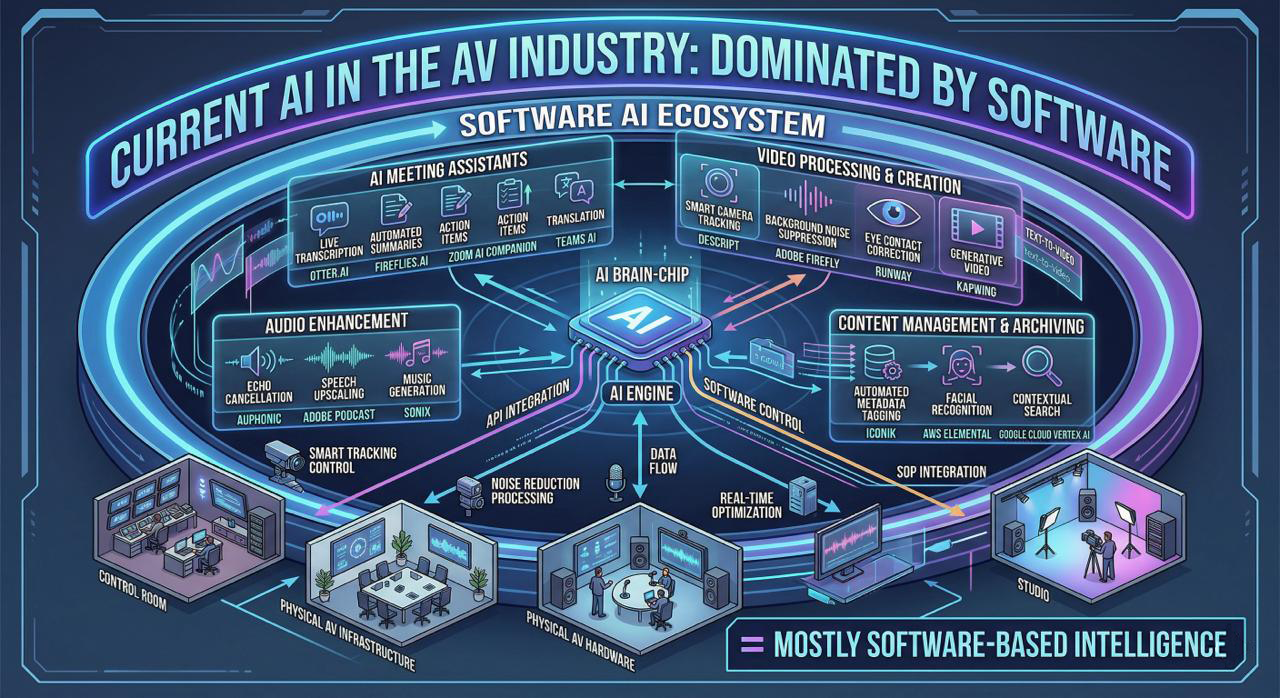
AI is already enabling:
- Smart camera tracking
- Intelligent audio processing
- Automated meeting insights
- Adaptive room environments
This convergence is not optional, it is becoming the baseline expectation.
Leadership takeaway: AV decisions are now technology strategy decisions.
3. Simplicity Is the New Benchmark
One of the biggest misconceptions is that more technology equals better performance.
In reality, users expect meeting rooms to “just work” – regardless of platform or device.
This has led to the rise of:
- Interoperable meeting systems
- Platform-agnostic collaboration
- One-touch meeting experiences
Leadership takeaway: The best AV system is the one your teams don’t have to think about.
4. AV-Over-IP Is the Backbone of Modern Systems
If there is one concept every non-tech leader should understand, it is this:
AV is now network-based.
The shift to AV-over-IP allows organisations to:
- Scale systems easily
- Integrate across locations
- Manage systems remotely
- Reduce infrastructure complexity
This transition is a key driver behind the industry’s growth and transformation.
Leadership takeaway: Future-ready AV is built on network infrastructure, not isolated hardware.
5. Data Is Becoming the Most Valuable Output of AV Systems
Traditional AV delivered output (audio + video).
Modern AV delivers insight.
AI-enabled systems now provide:
- Room utilisation data
- Meeting performance analytics
- Predictive maintenance alerts
This enables organisations to move from reactive support to proactive optimisation.
Leadership takeaway: AV is no longer just operational, it is measurable and optimisable.
6. Experience Is the real KPI
AV success is no longer defined by installation.
It is defined by:
- How quickly meetings start
- How clearly people communicate
- How consistently systems perform
Industry thinking has already shifted from “what equipment do we need?” to “what experience do we want to create?”
Leadership takeaway: AV should be designed around people, not technology.
7. Standardisation Matters More Than Innovation at Scale
For growing organisations, inconsistency is the biggest hidden cost.
Different systems across offices lead to:
- Training issues
- User frustration
- Reduced adoption
Modern AV strategy focuses on standardised experiences across locations, ensuring consistency in performance and usability.
Leadership takeaway: Scale requires standardisation, not experimentation.
8. Security and Sustainability Are Now Core Requirements
As AV systems become network-connected, they also become potential security entry points.
At the same time, sustainability is no longer optional, it is a procurement criterion.

Organisations are prioritising:
- Energy-efficient systems
- Longer lifecycle designs
- Remote management to reduce service visits
Leadership takeaway: AV decisions now impact compliance, risk, and ESG goals.
9. AV Industry Is Growing and Getting More Strategic
The global AV industry is projected to reach $402 billion by 2030 (Source: AVIXA Research), driven by digital transformation and workplace evolution.
This growth is not just about technology – it reflects a deeper shift:
AV is becoming central to how organisations communicate, collaborate, and operate.
Final Thoughts: What This Means for Non-Tech Leaders
You don’t need to become an AV expert.
But you do need to ask better questions:
- Are our collaboration spaces intuitive?
- Are our systems scalable across locations?
- Are we designing for experience or just installing technology?
- Are we future-ready or just upgraded?
Because the organisations that get AV right are not the ones with the most technology.
They are the ones with the most thoughtfully designed environments.
About Online Instruments
At Online Instruments, we help enterprises move beyond AV installation towards experience-led workplace transformation.
With 20+ years of consulting, engineering, and integration expertise, we design scalable, secure, and future-ready AV environments that simplify collaboration, improve performance, and support long-term business growth.