For decades, the rhythm of an Indian classroom was set by the scratch of chalk and the rustle of textbook pages. But walk into a school today, and the atmosphere has fundamentally shifted. This rapid transition from traditional boards to interactive displays isn’t just a fleeting post-pandemic trend. It is a massive, systemic response to a shift in how a new generation of students learns and how modern educators need to work.
The End of Passive Learning
The surge in adoption is driven by a perfect storm. Schools finally possess the reliable infrastructure they lacked a few years ago, and the lingering tech-phobia that once kept teachers at a distance has largely evaporated. More importantly, students today arrive in the classroom with a baseline expectation for digital engagement.
When an educator can seamlessly switch languages mid-lesson to clarify a concept, or pull up a high-definition visual that instantly makes an abstract idea click, the friction of traditional teaching disappears. We have moved past the era of viewing interactive displays as just expensive whiteboards; today, they function as intuitive teaching assistants.
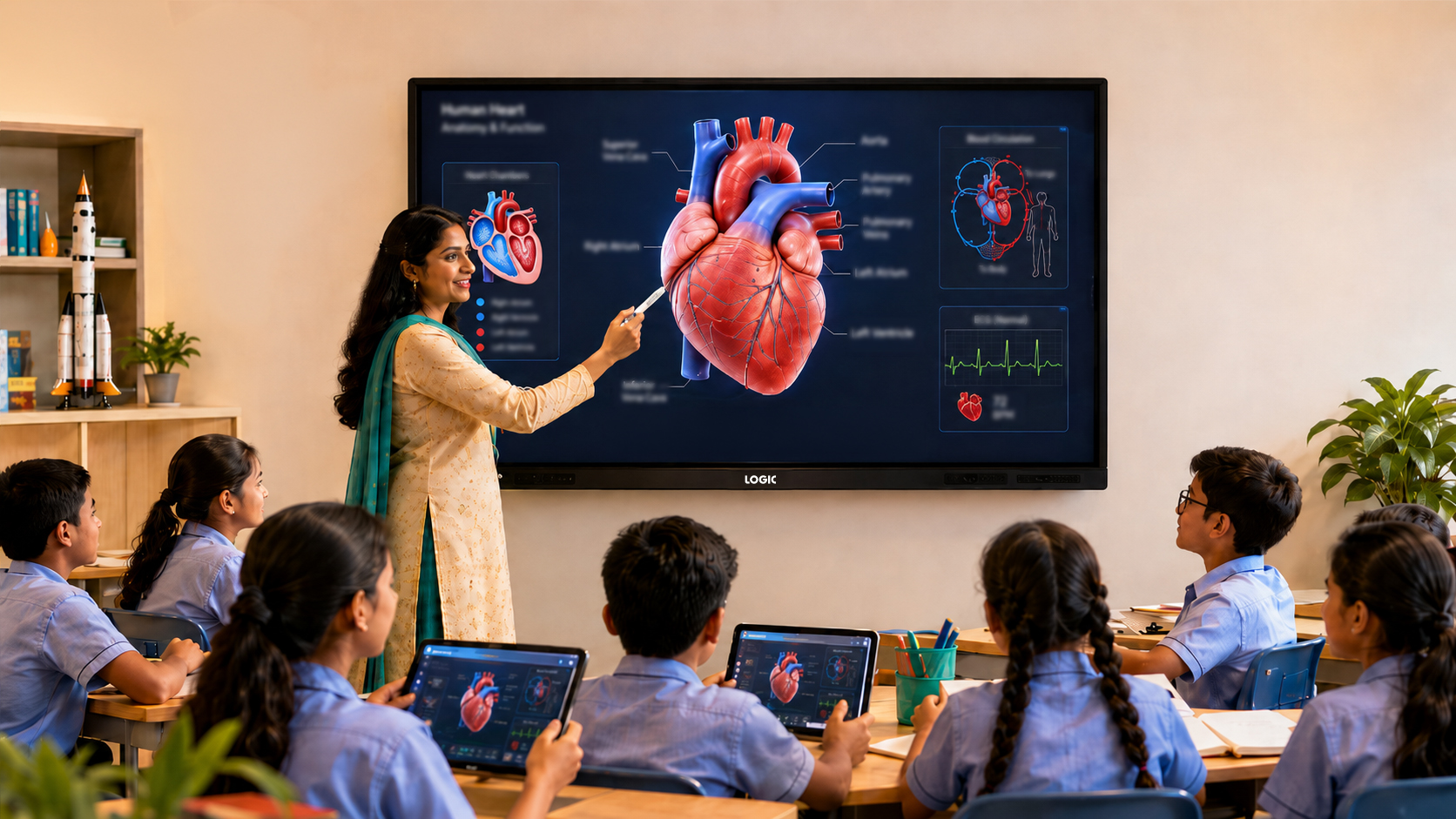
Consider a standard biology lesson. Instead of pointing to a static, two-dimensional diagram in a textbook, a teacher can manipulate a 3D model of a human heart, zooming in on valves and chambers while the class watches. History comes alive with actual archival footage rather than just dates to memorize. It transforms a one-way lecture into an active conversation. Kids who traditionally struggled with textbook concepts often finally get it when they can see and interact with the material. Active learning beats passive consumption every single time.
When Technology Becomes Invisible
The most exciting innovations shaping the next generation of classroom tools aren’t about adding more complex buttons; they are about making the technology feel entirely natural and almost invisible.
We are moving toward a reality where a teacher can draw a rough sketch of a cell on the board, and the system instantly translates it into a properly labelled, professional diagram. Cloud connectivity means lessons aren’t trapped in a single physical room; educators can access their materials from anywhere. With multi-device compatibility, students can cast their work directly from a tablet to the main display. As voice and gesture controls become more fluid, the technology handles the heavy lifting in the background, allowing the educator to focus purely on the art of teaching.
The Made in India Imperative
Of course, the transition isn’t without its hurdles. The biggest worry for most institutions isn’t the hardware itself, but the human element: Will our staff actually be comfortable using this?
Overcoming this requires shifting away from generic global solutions and focusing on the specific realities of the Indian education system. The hardware must be built to withstand the rigors of our environment from power fluctuations to dust and heavy, continuous usage.
This is where localized manufacturing changes the game entirely. Building these ecosystems, such as in our manufacturing facilities in Bangalore, isn’t just a logistical advantage; it is a strategic imperative. It allows for the creation of high-quality technology that remains financially accessible. This is the crucial key to democratizing modern education. Whether equipping a premium private academy in a metro city or a government setup in a rural district, pricing should never be the barrier that prevents a child from accessing a 21st-century learning experience.
The Borderless Future
Looking ahead, the four walls of the classroom will continue to expand. We are moving toward a highly personalized educational landscape where displays adapt to individual learning styles in real-time, and cloud-based systems make content sharing seamless across different schools and regions.
The ultimate goal of education technology isn’t to replace the traditional teaching experience, but to elevate it. By creating a borderless, intuitive environment, we are giving teachers the freedom to inspire, and students the canvas they need to truly engage.